
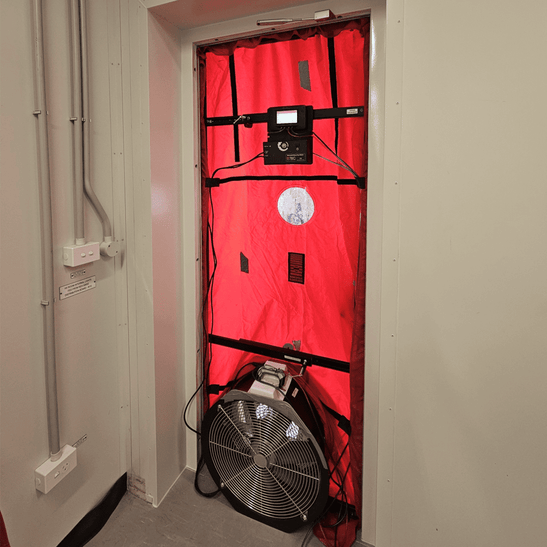
Server rooms protected by a total flooding gas system need enclosure integrity testing, because the system only works if the room holds the agent. Whether testing is also a formal requirement comes down to the building’s own paperwork. Across Perth and regional sites, enclosure integrity testing in WA still gets treated as optional paperwork until a discharge goes wrong.
Which Server Rooms Actually Need It
Any server room protected by a total flooding gas system needs enclosure integrity testing, commonly at commissioning and regularly after that. Total flooding means the system fills the whole room to a design concentration, so the room becomes part of the system. If the room can’t hold the gas, the cylinder bank is just expensive furniture. Rooms that sit squarely in scope include those protected by:
- Synthetic clean agents such as FM-200 (HFC-227ea) and Novec 1230 (FK-5-1-12), which are heavier than air and drain out through low-level gaps
- Inert gas systems such as IG-541 and IG-55
- Any gaseous system that’s been replaced or redesigned since the room was last tested
For both agent families, the leakage data also helps engineers check pressure relief vent sizing.
The redesign point catches owners out. A new or redesigned system can bring a different agent or design concentration, and a different agent behaves differently in the same room. A result measured against the old design doesn’t prove the room suits the new one.
Server Rooms That Can Skip It
A server room protected only by sprinklers or detection doesn’t need enclosure integrity testing, because nothing depends on the room holding an agent. A door fan result there has no design hold time to be measured against. Rooms that generally fall outside scope include:
- Rooms protected only by sprinklers
- Spaces relying only on detection and portable extinguishers
- Comms cupboards with no fixed suppression
The label on the door doesn’t decide it, and a small comms room with one gas cylinder is as much in scope as a data hall. Sprinklered rooms that also carry a gas system are in scope as well.
Why a Commissioning Pass Doesn’t Settle It
A commissioning pass only shows how the room performed on the day it was tested. Server rooms are modified constantly, and many changes open leakage paths that nobody passes on to the fire contractor.
Here’s a hypothetical that turns up in various forms. A room protected by FM-200 gets chimney-style cabinets to manage heat, with exhaust ducted into the ceiling void. That void sits outside the sealed envelope.
Each chimney is now a large high-level opening. The heavy agent spills out through gaps near the floor while the chimneys let replacement air in up top. The agent layer drops down the racks far faster than the design allows.
Nobody involved saw it as a fire job. The IT contractor saw a cooling upgrade, and the fire contractor found out at the next service. The common line in the trade is that a room’s been modified the moment anyone other than the fire contractor touches it.
The size of the original pass matters too. A room that scraped through at commissioning has almost no headroom, so one unsealed penetration can push it below its required hold time.
Small Rooms Are Often More Sensitive to Leakage
Small gas-protected rooms are often more sensitive to leakage than large ones. A gap that a large data hall could tolerate can pull a small comms room below its required hold time.
The reason depends on the agent. Heavier-than-air clean agents such as FM-200 and Novec 1230 settle into a layer, and its top edge drops as agent leaks away near the floor. For a given leak, that layer falls faster over a smaller floor area.
Inert gases such as IG-541 and IG-55 sit much closer to the density of air and tend to stay mixed through the room. There, the same leak dilutes the agent faster in a small room than in a large one.
Small comms rooms carved out of office floor space can also carry the leakage paths that do the most harm. Partitions that stop at a suspended ceiling leave the void above outside the envelope. Standard office doors without drop seals are another regular find.
Frequently Asked Questions
Is Enclosure Integrity Testing a Legal Requirement for Server Rooms in WA?
It depends on the building’s approval documents and the maintenance standard specified for it. Where AS 1851 applies to a gas-protected room, regular enclosure retesting is required, and annual testing is the norm. Rooms without a gaseous system don’t need an enclosure test, because there’s no agent for the room to hold.
Does a Sprinkler-Only Server Room Need Enclosure Integrity Testing?
No. The test checks whether a room can hold a gaseous agent, and a sprinkler-only room has none to hold. If a gas system is added later, or already sits alongside the sprinklers, the room needs testing.
Does a Small Comms Room with Gas Suppression Need Testing?
Yes, if the system is total flooding. Small rooms are often more sensitive to leakage, so their size is no reason to skip it. The system relies on the room holding gas regardless of how big it is.
Key Takeaways
One question decides whether a server room needs testing: does a total flooding gas system depend on the room holding agent? If it does, the room’s ability to hold that agent has to be proven and kept current.