
A cool room refrigeration replacement usually succeeds or fails on its smaller parts. The expansion valve, filter drier, pipework and controls largely decide how well new plant performs over its working life.
A cool room refrigeration unit is the split system that pulls heat out of an insulated room. It’s made up of an evaporator inside, a condensing unit outside, and the pipework, valves and controls joining them. Replacing one half without matching it to the other risks a capacity mismatch, which often shows up as short cycling.
What a Full Cool Room Unit Replacement Includes
A proper replacement covers the whole refrigeration circuit, from the evaporator inside the room to the condensing unit outside. Every part needs to suit the same refrigerant and capacity for the new plant to run as designed.
- Recovery of the old refrigerant, which legally requires a technician holding a Refrigerant Handling Licence
- A new evaporator matched to the room’s load and air throw
- A new condensing unit sized for local summer ambient temperatures
- An expansion device, with electronic valves increasingly specified on small commercial rooms
- Fresh line components, including the filter drier, sight glass and solenoid
- An electronic controller with probes and alarms
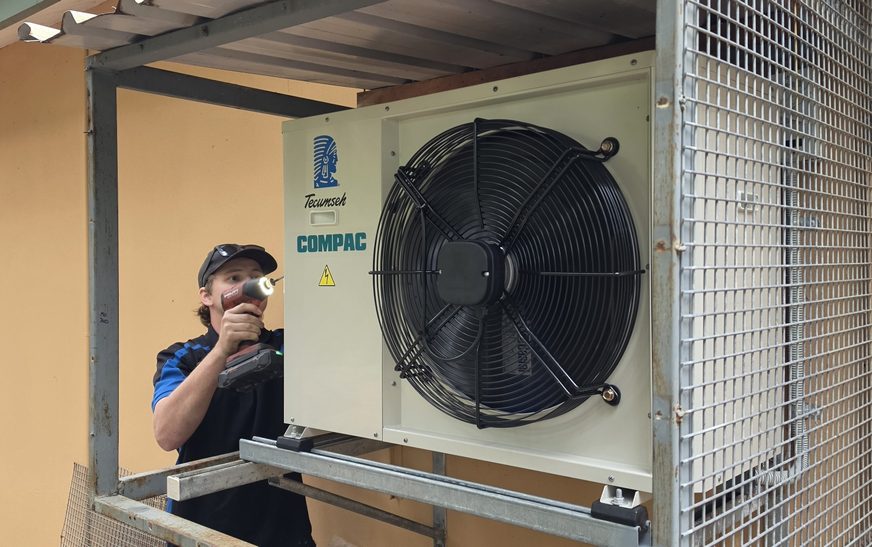
- A protective cage where the outdoor plant is exposed to knocks or tampering
Mixing brands across these parts is normal, as long as capacities and refrigerant line up.
The Condensing Unit Sets the Ceiling
The condensing unit determines how much heat the system can reject, so it sets the upper limit on performance. If it’s undersized, the room drifts warm through every heatwave.
- The compressor brand and type, with Tecumseh common in small commercial plant
- Condenser coil size and fin spacing, since tight fins clog faster near dusty yards
- Condenser fan speed control to hold stable head pressure in cooler months
- A crankcase heater to stop refrigerant migrating into the compressor oil during off cycles
- High and low pressure switches as basic compressor protection
- A liquid receiver sized for the full charge, which allows the system to pump down
The common line in the trade is to select condensing units at the hottest realistic ambient temperature. In Perth, regional WA and much of inland Australia, that usually means rating at 43°C or higher. Plant tucked against a west-facing wall or under a tin awning will see hotter air again.
Head pressure control matters in winter too. Low condensing pressure can starve a thermostatic valve and push room temperature up. Electronic valves are less sensitive to this, though stable head pressure still helps them run efficiently.
Matching the Evaporator to the Room
The evaporator needs to suit the room’s heat load and its physical layout. Its air throw has to reach the far shelves for the rated capacity to count.
- Air throw distance compared with the room’s length
- Fin spacing, with wider spacing coping better with moisture-heavy produce
- Off-cycle defrost, which usually suits rooms held at around +2°C or above
- Electric or hot gas defrost for colder rooms, where coils ice up faster
- A suitable drain pan arrangement and a properly trapped drain line
Placement problems usually only show up once stock starts blocking the airflow. A coil blowing straight at the door pulls warm air in every time it opens. A short-throw coil in a long room leaves the back warmer than the probe reads.
Drain lines are easy to overlook because they’re out of sight once the job’s finished. An untrapped drain lets warm, moist air into the room and feeds ice on the coil.
Expansion Valves: Where Electronic Control Earns Its Keep
An electronic expansion valve (EEV) meters refrigerant into the evaporator more precisely than a thermostatic valve. That keeps room temperature steadier and protects the compressor from liquid flooding back to it.
Thermostatic expansion valves have done the job for decades and still suit many small rooms. They’re slower to react and tend to hunt when loads swing. A delivery of warm stock or a busy service with the door propped open will show it.
R448A adds another wrinkle. It’s a zeotropic blend, meaning it boils across a range of temperatures as it moves through the evaporator. That shift, known as glide, makes superheat harder to read and set.
An EEV paired with a matching controller handles that glide more reliably than a mechanical valve set by feel. Electronic valves cost more upfront, and on rooms holding valuable stock, most refrigeration techs reckon the extra spend is easy to justify.
Frequently Asked Questions
Can the Old Evaporator Be Kept When Replacing the Condensing Unit?
Usually not on older systems. The old coil may not suit the new refrigerant or capacity, and it can hold contaminated oil. A mismatched pair struggles to hold temperature and wears the compressor faster.
Can R448A Replace R404A Without Other Changes?
Only with some adjustments. The two are close in pressure and capacity, and both use POE oil, so an oil change usually isn’t needed. The main changes involve the expansion valve setup and allowing for R448A’s temperature glide. On a full replacement, the new plant is simply selected for R448A from the start.
Does a Small Cool Room Need an Electronic Expansion Valve?
It isn’t mandatory. An EEV adjusts continuously to load changes, which suits rooms with frequent door openings or plant running on R448A. Thermostatic valves remain a reasonable choice on simple rooms with steady loads.
Key Takeaways
The parts that decide a replacement’s success are mostly the unglamorous ones. A sound cool room refrigeration upgrade comes down to matching every component as one system.
- Condensing units perform best when sized for the hottest local conditions, with head pressure control fitted
- Evaporator air throw needs to reach the full length of the room
- Electronic expansion valves handle R448A’s glide more reliably than thermostatic valves
- Filter driers, sight glasses and solenoids are replaced every time the system is opened