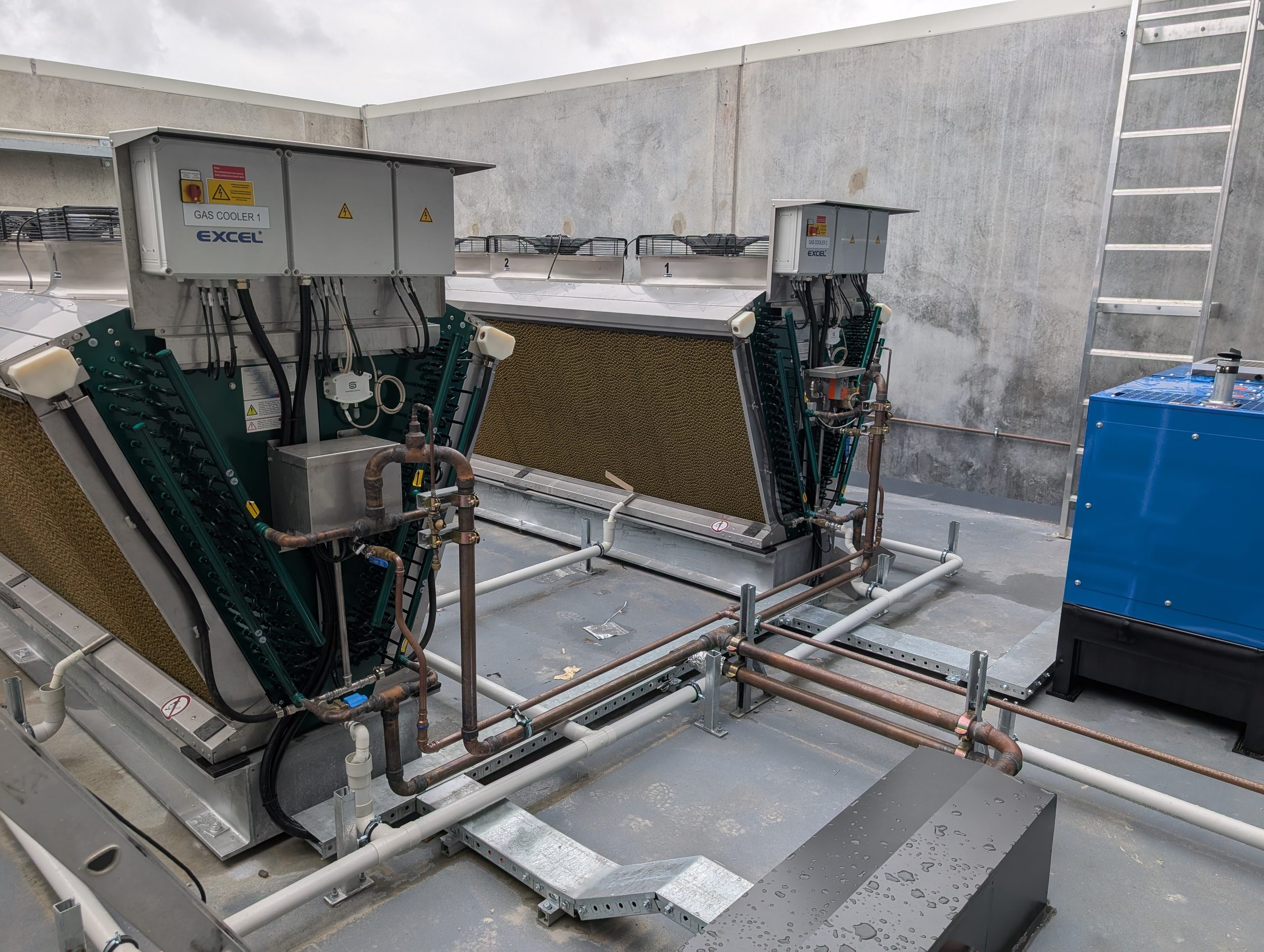

Old commercial evaporative coolers need replacing because they lose cooling capacity and become harder to keep hygienic long before they stop running. The decline’s gradual, so a unit that still hums and moves air can look fine on paper. That’s why commercial evaporative cooler replacement tends to sit near the bottom of the capex list.
Cooling Capacity Drops Long Before the Unit Fails
Old evaporative coolers lose cooling capacity gradually, so a building gets warmer each summer while the unit appears to run normally. Most service techs reckon the complaints show up years after the performance started slipping. The usual causes are mechanical, and they build on each other:
- Mineral scale builds up in the pad flutes, cutting both airflow and the wetted surface area available for evaporation.
- Worn pumps and clogged water distributors leave dry streaks across the pad face, letting hot air slip straight through.
- Belts stretch and pulleys wear on older fan drives, so delivered airflow falls below what the system was designed for.
- Warped cabinet panels and perished seals let unconditioned air bypass the pads altogether.
On a 38°C day at 20 per cent relative humidity, the effect is easy to measure. A drop from 85 to 65 per cent saturation efficiency pushes supply air roughly three to four degrees warmer.
In a warehouse or workshop, that’s enough for the afternoon shift to cop a hammering.
Water Quality and Hygiene Get Harder to Manage
Older units usually lack the water management controls that keep tank water clean, so scale and bacterial growth become harder to control. Many current commercial coolers use salinity sensors and automatic drain cycles. A lot of units installed 15 or more years ago rely on a fixed bleed-off valve and not much else. That gap tends to show up in predictable ways:
- Fixed bleed-off either wastes water constantly or lets dissolved salts concentrate until scale forms on everything.
- Without an automatic drain-and-dry cycle, water sits stagnant in the tank between hot days.
- Galvanised trays and steel tanks corrode, shedding rust and sludge into the recirculating water.
- Pads develop biofilm that flushing won’t shift once it’s established.
AS/NZS 3666.2 sets out operation and maintenance requirements for microbial control, and it includes a specific clause on evaporative air-cooling equipment. One major Australian manufacturer specifies commercial servicing every three months or twice a year. Hitting that schedule on a decades-old unit takes far more labour. Units with automatic drain cycles dry themselves after shutdown, which cuts down the hands-on work.
Facility managers in hard-water areas feel this most, because scale speeds up every other problem on the list.
Parts, Repairs and the Sunk Cost Problem
Repairing an old cooler often costs more over a few years than replacing it. Parts get scarce, and each fix tends to expose the next failure. Controllers, pumps and motors on older models are often discontinued, so technicians end up fitting adapted or aftermarket parts.
A typical pattern runs like this. The pump gets replaced in December, then the controller fails a few months later. Each repair looks sensible on its own. Together they’ve paid for a decent chunk of a new unit, and the worn cabinet and tank are still sitting there.
Repair’s still the sensible call on a mid-life unit with a sound cabinet and an isolated fault. The common line in the trade is to cost replacement properly once a single repair nears half the price of a new unit. The same goes for any cooler past about 12 to 15 years old.
Older Units Burn More Power for Less Cooling
Older evaporative coolers typically use more electricity per unit of cooling, mainly because of dated fan motors and fixed-speed drives. Many legacy units run AC induction motors through belt drives, which lose energy to friction and slippage. Plenty of current commercial models use EC (electronically commutated) motors with variable speed control.
There’s also a knock-on effect that rarely gets counted. As cooling drops off, occupants crank the fan to maximum and leave it there. Run hours climb, and energy use climbs with them.
For a site running several large coolers through a long summer, that cost sits quietly in the power bill.
Frequently Asked Questions
How Long Does a Commercial Evaporative Cooler Last?
Commonly quoted figures for commercial units sit somewhere around 12 to 20 years. Hard water and coastal salt exposure tend to push a unit toward the lower end. Pads usually need replacing every few years, well before the cabinet gives out.
Is It Worth Replacing the Pads Instead of the Whole Unit?
Replacing the pads alone is worth it when the rest of the unit’s in good condition. If the pump, fan drive and tank are also worn, fresh pads only mask the decline for a season or two. A technician should check cabinet and motor condition before recommending pads alone.
Do Old Evaporative Coolers Pose a Legionella Risk?
Old evaporative coolers can carry a Legionella risk where water sits stagnant in the tank or biofilm builds on the pads. AS/NZS 3666.2 includes maintenance requirements specifically for evaporative air-cooling equipment. Older units without automatic drain-down are harder to keep within those requirements.
Key Takeaways
Old commercial evaporative coolers lose performance gradually, and the cost of keeping them going builds up quietly over several years. The main reasons replacement makes sense are these:
- Scaled pads and worn components can push supply air several degrees warmer than design.
- Older units lack modern water management, which makes AS/NZS 3666.2 maintenance harder and more labour-intensive.
- Discontinued parts turn routine repairs into a costly, recurring cycle.
- Legacy fan motors and drives use more power for the cooling they deliver.
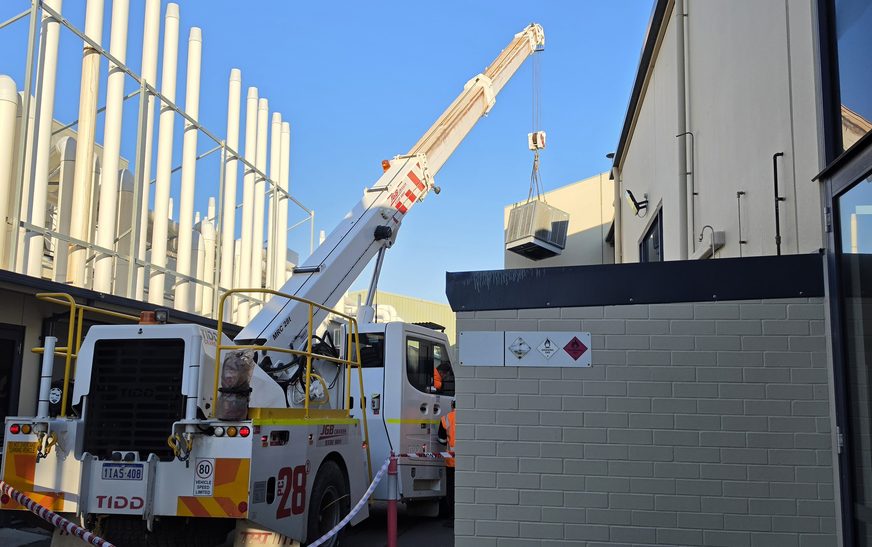
- Units in hard-to-reach positions get serviced less often and cost more to remove.
For ageing units with scale and access problems, commercial evaporative cooler replacement is usually the cheaper long-term option.