
Safety sign placement decides whether a warning changes what someone does at the moment it counts. Most Australian workplaces already own plenty of signs, and plenty of them are mounted where nobody reads them in time.
A sign’s position also affects how a site is judged after an incident. Getting safety sign placement right comes down to the people approaching a hazard and the direction they come from.
What Safety Sign Placement Actually Means
Safety sign placement is positioning a sign so the intended person sees it with enough time to respond safely. It accounts for height, distance and viewing angle, along with lighting and nearby visual noise.
Site managers tend to work from the idea of a decision point. That’s the spot where a worker chooses to stop, put on PPE, change route or turn back. A sign has to be readable before that point to change anything.
Reaction Distance Decides Whether a Sign Works
A sign only works when it’s read early enough for the approaching person to act on it. That window shrinks as travel speed rises and reaction time stretches. Factors that set the size of the window include:
- travel speed, since a forklift at 10 km/h covers close to 2.8 metres every second
- walking pace of roughly 1.4 metres per second, slower when someone’s carrying stock
- the second or more it takes to notice a sign and react
- glare and low light near roller doors and on night shift
- a driver’s seated position, which changes what falls within their line of sight
Applied to a forklift crossing, those numbers leave little margin. A “Pedestrians crossing” sign fixed right at the crossing line gives a driver almost no usable distance.
AS 1319, the Australian Standard covering safety signs for the occupational environment, links sign dimensions to viewing distance. Read from further away than it was sized for, a sign’s text and symbol get harder to make out.
Why Viewing Angle Changes What Gets Seen
Viewing angle decides whether a sign faces the people it’s meant for, and it’s one of the most overlooked parts of placement. A sign can sit at a sensible height and distance and still be missed. Common angle problems include:
- signs mounted flat on corridor walls, which walkers see almost edge-on
- signs on doors that only face one direction of travel
- signs blocked by columns or racking uprights from certain approaches
- signs on two-way routes that only serve traffic heading one way
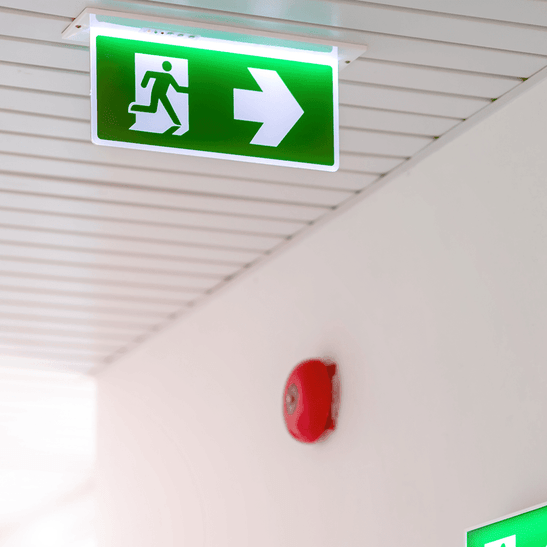
Angle problems often go unnoticed because signs tend to get checked from the front, standing still. Flag-mounted and overhead signs face oncoming traffic directly. On two-way routes, double-sided signs give both directions a proper crack at reading the message.
How Poor Placement Creates Sign Blindness
Irrelevant or excessive signage trains workers to tune out signs altogether. Psychologists call this habituation, and on site it’s known as sign blindness. Placement habits that tend to feed it include:
- entry points loaded with so many signs that none stands out
- danger signs on minor hazards, when they’re meant for risks likely to cause death or serious injury
- warning signs for plant that was decommissioned years ago
- signs fixed to whatever surface is easiest to drill, regardless of where the hazard sits
- safety signs sharing wall space with rosters, posters and digital screens
Each irrelevant sign makes the next one easier to ignore. The sign that genuinely matters ends up getting the same passing glance as the rest. Pulling down outdated signs costs next to nothing.
Why Site Newcomers Depend on Good Placement
People new to a site depend on placement because they don’t yet know where the hazards are. Australian workers’ compensation data consistently shows higher injury rates among workers in their first year in a job. Groups with little or no site familiarity include:
- contractors and delivery drivers on site for a single job
- new starters in their first few weeks
- labour hire workers rotating between sites
- visitors such as auditors and clients
- workers with limited English, who rely on symbols, colour and position
Inductions cover the main hazards, though a sign seen once in a site office isn’t much use halfway down an unfamiliar aisle. Well-placed signs carry that induction information out onto the floor.
Frequently Asked Questions
Is Safety Sign Placement a Legal Requirement in Australia?
Some signage is legally required, including signs at confined space entries and in asbestos areas. Hazardous chemical and dangerous goods storage above set quantities also triggers placarding, with thresholds varying between jurisdictions. Beyond those, a sign that can’t be seen in time is unlikely to satisfy the general duty to manage risk.
Who Is Responsible for Safety Sign Placement?
In most states and territories, responsibility sits with the PCBU, short for person conducting a business or undertaking. That’s usually the employer, along with anyone who has management or control of the workplace. Victoria operates under its own OHS Act, where the equivalent duty falls on employers.
Do Safety Signs Count as a Risk Control?
Safety signs count as an administrative control, which sits low on the hierarchy of control. They’re designed to support engineering controls such as guarding, barriers and segregation. A sign relied on as the only control for a serious hazard tends to draw hard questions from inspectors.
Key Takeaways
Safety sign placement determines whether a sign changes behaviour, and regulators assess signage on that basis. A sign’s value depends on where it sits relative to the people approaching it.
- Signs work at decision points, with enough distance for people and plant to react.
- Signs mounted square to the direction of travel are far easier to read on approach.
- Clutter and outdated signs drive sign blindness across a whole site.
- Contractors, visitors and new starters lean heavily on placement to find hazards.
- Layout changes shift decision points, so placement needs rechecking each time.
- Signs support engineering controls and carry limited weight on their own.