
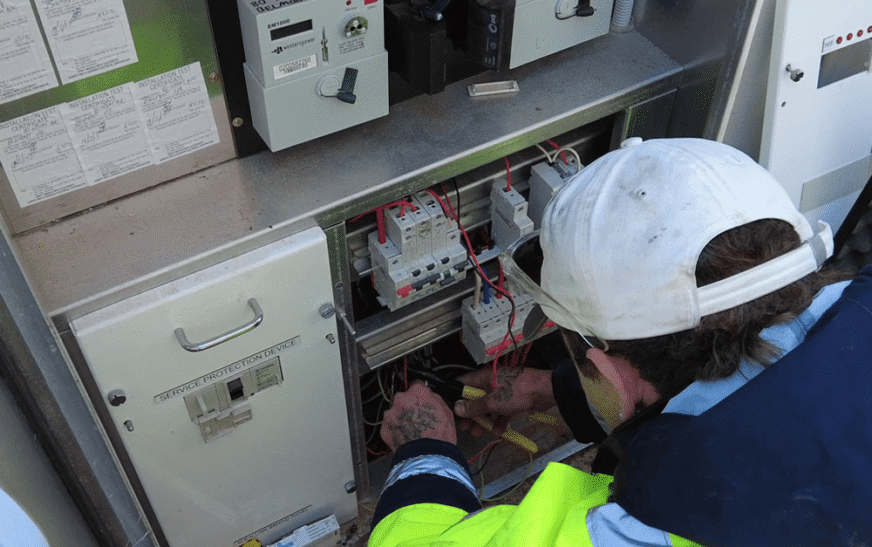
A commercial switchboard is due for replacement when repairs stop delivering reliable service. The most common triggers are discontinued parts and new work the old board can’t legally accommodate. Age matters too, but mostly as a reason to get the board assessed.
A switchboard is the enclosure that receives the incoming supply and divides it into protected circuits. It houses the main switch, circuit breakers, residual current devices (RCDs) and often the metering. In a commercial building, it’s the centre of the commercial electric service, and every tenancy depends on it.
What Happens When Replacement Parts Can’t Be Sourced?
A board is effectively due for replacement once a failed breaker can’t be swapped for a compliant, like-for-like part. Field experience shows it’s a reliable test that’s rarely checked until something breaks. The check itself is straightforward and can be done well before any failure:
- The electrician photographs the board and identifies every breaker range installed.
- Each range is checked against current manufacturer supply, with second-hand-only ranges noted.
- Critical circuits are flagged, such as lifts, fire panels, cool rooms and comms rooms.
- A replacement is priced while there’s no pressure to accept the first quote.
A common scenario involves a 1980s board serving a strip of retail tenancies. A breaker fails late on a Friday, and the original range is long gone.
The electrician hunts for second-hand stock or fits an adaptor kit. That gets the tenancies trading again, but mixing breaker brands on one chassis creates a combination the manufacturer never tested. Poor busbar contact and overheating can follow over time.
Once critical circuits depend on discontinued parts, every repair gets harder and slower.
Which Compliance Triggers Force a Switchboard Replacement?
Compliance usually forces replacement when new work is added to an old board. Under AS/NZS 3000, new or altered circuits must meet current rules, and many older boards physically can’t accommodate them. The most common triggers include:
- New final subcircuits needing 30mA RCD protection, with no space or compatible chassis for the devices
- An insurer or landlord requirement following an inspection report that flags hot joints or overloaded connections
- A change of use, such as office space converted to a medical suite or food premises
- Solar, battery or EV charging installations needing network approval and a main switch upgrade
- A supply capacity increase the existing main switch and enclosure can’t handle
Asbestos backing complicates any modification to an old board. Workplace safety rules restrict power tool use on asbestos to limited cases with dust controls in place. Under the WA WHS regulations, which commenced in 2022, removing non-friable asbestos of 10m² or less doesn’t need a licence, though strict controls still apply. In practice, those restrictions often tip the decision toward full replacement.
The network operator may also require metering or main switch changes before approving larger connections. In WA, Western Power runs the Perth and South West network, including centres like Bunbury, Albany and Kalgoorlie. Horizon Power covers regional and remote areas outside that grid, such as the Pilbara and Kimberley. Approvals can take weeks, which matters when a tenant’s waiting on a handover date.
When Is the Best Time to Replace a Switchboard?
The best time to replace a switchboard is during another project that already requires a shutdown. Bundling the work avoids paying for a second outage. The windows that suit replacement best are:
- Between tenancies, when a floor’s empty and nobody’s trading
- Before an EV charging rollout, since chargers add substantial continuous load that older boards weren’t designed for
- Alongside a major HVAC replacement, when plant is already being isolated
- Ahead of a sale or refinance, as building condition reports routinely flag ageing boards
- During a rooftop solar project, which often involves main switchboard modifications anyway
Most operators reckon the changeover itself is the easy part. Coordinating tenants, after-hours access and temporary power is where budgets tend to blow out.
A new board should also be sized with 20 to 25 per cent spare capacity. That’s a common rule of thumb for future load, and it’s far cheaper to build in at the start.
Frequently Asked Questions
How Often Should a Switchboard Be Checked for Replacement Signs?
A visual inspection and thermal imaging survey every 12 months is a common guide for commercial switchboards. A full load review often follows every three to five years, or whenever major equipment is added. Thermal imaging picks up hot joints and overloaded connections, which says more about a board’s condition than its age does.
Does Adding EV Chargers Mean Replacing the Switchboard?
It often does, particularly on older boards with little spare capacity. AC chargers typically add 7kW to 22kW each, while DC fast chargers commonly draw 50kW or more. A load calculation against the board’s rating shows whether it can carry the chargers or needs replacing.
Is It Legal to Keep Using an Old Switchboard?
Generally, yes, provided it’s safe and hasn’t been altered in ways that breach current rules. AS/NZS 3000 doesn’t usually require existing installations to be upgraded when the standard changes. New work connected to the board must comply, though, and owners still carry workplace safety duties to manage electrical risk.
Final Thoughts
Replacement is usually due well before a switchboard fails outright. Parts that can’t be sourced and compliance hurdles from planned work are the signals worth acting on first.
Pairing the changeover with a fit-out or tenancy change means the outage gets paid for once. Treating the board as a planned item in the building’s commercial electric service budget avoids an emergency changeover.